
Estimated reading time: 5 mins
Was your last performance review/appraisal enjoyable? Worthwhile? Inspiring? Constructive? It should be all of these things, if done right. But chances are, it wasn’t. It’s a common problem.

Over 800 professionals from over 600 companies were surveyed and the results showed that over 70% felt their performance reviews were ineffective. I doubt you’re surprised, considering your own experience.
Interestingly, the survey confirmed something unexpected that many of the people who suffer the least satisfactory performance reviews didn’t ask enough questions. There is a strong correlation between the effort put into the review by the employee and their satisfaction.
There is one critical point I want to make upfront. Not all managers who conduct appraisals are experienced in the process. Despite training. Every manager has their first time, and it takes more than one go to become good at it. Many new managers are just as nervous about conducting your review as you might be.
What are managers looking for in your performance appraisal?
- Managers set out to review where you have performed well, and where improvements are required
- They’re looking for your ownership and accountability of your own performance and success
- They want to identify the impact your performance has on the company, team and co-workers
- Managers seek to understand what steps are required to improve performance
- They want to be sure that you will take responsibility for these improvements
Whether you have a manager who is a novice at conducting reviews, or a seasoned expert, the challenge for you is the same: ask powerful questions in your performance review in order to get the most from it. Because this will…
- improve your engagement in the process;
- it will show that you’re serious about the process;
- it helps your manager/reviewer understand what is important to you;
- it provides you and your manager with an opportunity to direct future performance appraisals (together).
Over the years of being appraised, and appraising others, I’ve developed a set of questions that I know just work, backed up by years of research. They’re questions that I ask, and indeed have been asked, that have led to positive, constructive, satisfactory performance appraisals.
Firstly, the simplest and most powerful questions of all.
The first 3 questions will extract everything you need to know about your general performance from your manager.
They are really powerful because you’re asking specific questions about your behaviors. What’s more, they cover all bases. These are questions that are very difficult for your manager to fudge the answers on! I always ask these questions in my reviews, and I always get the most value from these questions alone. When you write a performance review, it is important to consider the following questions:
1. “What should I continue to do?”
2. “What should I stop doing?”
3. “What should I start to do?”
Ask yourself these questions now. What do they make you think? Because of their directness, depth and coverage, it is these 3 questions that form the basis of most 360-degree feedback methods. They drive at three important aspects of your performance:
- What you do that is effective
- What you do that is not effective
- What you must now do to increase your effectiveness
If you only ask 3 questions in your review, these are the ones to ask.
4. “What could I now do to deliver more value to our organization?”
This question is very powerful as it links goal-setting to company value creation. Value you will create. It demonstrates your willingness to be interested and aware in the commercial success of your company (not just your own interests) and that you are serious in taking personal accountability for it.
Even better: suggest your own answers to the above questions – using actions that stretch the boundaries of your role.

5. “What could I do to give me the best opportunity to move onto the next level in this organization?”
is a question which asks your reviewer to be explicit about the behaviors, skills, competencies and qualifications you will need to demonstrate to progress in your career; this might be grade, position, pay, or whatever. Don’t be afraid to ask this question – many people avoid it. If you don’t know what you have to achieve to be ready for promotion, then how will you know when you have got there?
6. Ask your boss “What can I do to make you more successful?”
This is a very powerful question. Why? It works on two levels: 1) you’re suggesting that goals should be set and demonstrating your willingness to be measured (“..I do..” and “..more successful..” ), and 2) you are creating an opportunity to be delegated to, i.e. take some of the responsibility from your boss.
Great managers need to delegate to be successful, so create a situation where your manager can offer this to you.
The other advantage to asking this question is that your colleagues probably haven’t (unless they’re reading this post)
These questions work
Since being developed, these questions have been tried and tested by over 2,500 professionals. Most discovered that formulating a constructive set of questions in preparation for their Performance Appraisal resulted in increased satisfaction.
Moreover, 83% then found that the subsequent appraisal yielded even better scores. Why? Well what they discovered is that they then understood more clearly what adjustments they needed to undergo to make a greater contribution to the success of their organization.
In other words, they found that they didn’t just do their job better, but they helped their colleagues, managers and subordinates succeed too.
7. Is there a Seventh?
Do you have a ‘killer question’ that you’ve used in your performance review? Or is there a question you’ve always wanted to ask? Then leave a comment below and share your thoughts! Who knows, I might even add it into this post…?
Rock YOUR Next Performance Review
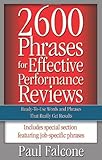 If you are the reviewer or reviewee during a performance appraisal, then here is an excellent book that shares phrases to use. It isn’t just a ‘say this, and then this…’ kind of book, it shows you what phrase-constructs to use in the right context to help make a performance appraisal as effective as it could be: 2600 Phrases for Effective Performance Reviews: Ready-to-Use Words and Phrases That Really Get Results.

I’d be curious to hear of any IT tech who’s experimented with qs 5.
The other questions I have used with various managers over the years. Success with these very much depended on the working relationship we enjoyed or not.
Another things about performance appraisals is that managers and staff tend to see these as somewht isolated ‘scheduled events’ in the business year.
I know more enlightened corps have mid-year reviews which is a step in the right direction. Ideally, the employee should be able to self-review progress over the year and flag any red-lights (or successes) at informal or formal 1-on-1s with their manager.
Here I’m thinking of the career development component of the performance appraisal process where there is a subtle pressure to include more goals and objectives than can reasonably be achieved even by a demi-god tech geek working 24/7 🙂
So, in summary – I believe monthly self-review of the agreed goals/project list is very important for the employee (because approx 50% of the work you will do in a year will likely not have been planned in any 1-shot career development meeting…)
@Mark – I’ve known a handful of people who have asked question 5 and in each case it was a success. One colleague from a while ago, Sarit, used this question regularly and discovered that a) sometimes her boss was ready to delegate, or b) in other times her boss wasn’t ready to delegate but became ready not long afterwards.
I totally agree about your point that the responsibility for review should be with the employee as much as the employer, and by taking this responsibility, the process is less of a punctuated series of events, but rather a continuous cycle, to the benefit of the employee.
Thanks for sharing
Pingback: Why Are Good Employees Hard To Find? « CPG Jobs
I’ve suggested, also, questions similar to question #5, but I think you need to know “what drives your boss crazy at night”. It’s great to ask the questions, but also observe during the year. It’s a real key to know these things, not only at review, but for career advancement.
Hi Robert. Great question. This gets right to the crux of the deep-set issues… and maybe we might be able to help. Thanks for your comment
Thanks for the food for thought, all too often I have been a passive partner in an appraisal…not anymore!
Thanks for your comment Richard. Hope you find a way to make your appraisal work for you, rather than it being ‘done’ to you. Simon
Great comments,
I add,
In which area(s) would you like to improve?
How Do You Want to be Rewarded?”
Manasa – I like this. This is a great couple of questions. They opens up the debate about two things: 1) what you want as a reward, which might not be as simple as cash; 2) what you’re then prepared to do to achieve the reward