
Estimated reading time: 4 mins
If you’ve been asked to ‘take the meeting minutes’ and don’t know where to start, then try here and you’ll soon be a minute-taking whizz-kid. I also include minutes templates for your convenience!
There comes a time (in most office-based jobs, at least) when we become important enough, or available enough, to take the ‘minutes’ of a meeting. In fact they are an important record of a meeting, and getting it right is crucial – or we spend more time trying to remember what was said, and who said it, in the next meeting.
The weird thing is, until you enter an office environment or similar where meeting minutes are taken, it’s an activity that is quite alien, and mostly unknown. I remember some poor chap a few years ago who was asked to take the meeting minutes, and when he distributed them after the meeting by email, this is what we got:
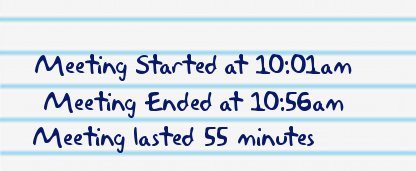
We literally received a log of the ‘minutes’ the meeting started and ended. It doesn’t help that that minutes are named as such.
What is Taking Meeting Minutes?
In its simplest form, minute-taking is documenting a record of discussion, decisions and actions to be taken and the date by when it needs to be completed; i.e. the ‘minutes’. The minutes are not a blow-by-blow transcript of the whole conversation (no-way!) – it’s purpose is to ensure that any agreements and actions are captured so that the people who took responsibility for them have something to refer back to.
The general process of taking minutes is this:
- Start of meeting – person taking the minutes is registered with the attendees, and then attendees are noted (and anyone missing recorded – often tagged as ‘apologies’). The start time of the meeting is recorded in the minutes
- The minutes of the previous meeting are reviewed and actions/updates reported and recorded in the minutes
- Whenever a discussion results in a statement of important news, a decision or an agreed action, it is recorded as a summary in the minutes (along with who said it, who agreed, who took the action, and by when the action will be completed)
- The meeting closes and the time noted in the minutes
- The minutes are typed up (if hand-written) and then distributed to attendees, the ‘apologies’ and then anyone else who has asked (and given permission) to receive them, normally by email
Hand-written meeting minutes, or typed in-situ?

I tend to take minutes on a laptop so I don’t have to type them up again after the meeting. It is easier if you use a template (links at the end of the article). I often populate some of the dicussion points ahead of time, based on the agenda. Then I just fill in the blanks on my laptop during the meeting.
Then again, I can ‘touch type’, and I can type fast. If you struggle to navigate a keyboard, then typing in-situ might not be a good option for you. Then, try hand writing them and typing them up later.
Knowing a bit about the subject helps when taking meeting minutes
Taking minutes is all about recording a summary of the important points and decisions. But what if you don’t know enough abut the subject to know what is important? Try looking at the minutes of the previous meeting to prepare for what is to come, and if you’re totally clueless, then speak to the meeting chair and ask him or her to provide you with cues as what to record!
Remember the context
Context is important when taking minutes. If a decision was taken, for example, note down a summary of how the decision was taken, who agreed and what points were drawn out. There is no need to write chapter and verse – summarize it in a statement that describes the process and the outcome.
You’re part of the meeting, too!
In most contemporary environments, the minute-taker is also a contributor to the meeting – so if you’re taking the minutes, you don’t need to stay out of the discussion. It’s important that you get involved in the meeting too, if that is what is expected. However, your contribution to the discussion should not be at the expense of the minute taking. If you need time to record something, then ask for it.
Don’t delay in sending the meeting minutes

In my experience, you shouldn’t wait too long after the meeting to type and distribute the minutes. We’re human beings – we forget stuff. Context is sometimes lost, or influenced by our own biases. The longer I wait to record the minutes, the harder it is to complete and the less accurate they become.
Meeting Minutes Templates
Here are some great templates for Microsoft Office: https://create.microsoft.com/en-us/template/meeting-minutes-(simple)-c690aa38-b9b1-494b-8c51-c2fe35c6c7d3
Or if you prefer OpenOffice: http://templates.services.openoffice.org/en/node/262

Yes, it really should be a skill taught (and practiced) in high school/college and then refreshed in a good new-hire induction plan.
That’s the theory…
In practice, where taking minutes can become a thankless chore are those meetings that have little structure i.e. no published agenda, weak chairperson skills/authority and a failure to set start and (stick to) agreed finish times.
Those templates look useful but will work best with someone who can touch type.
I like mind maps for creating minutes but in the corp world rarely saw this software in action. Now, in my own workspace, I can test and experiment with such tools (FreeMind is a good starter product.. and free!)
Hi Mark, thanks for your reply! Perhaps the templates could be printed out and completed by hand (and then, re-typed) – for those folks who can’t touch-type.
I share your view on the drudgery of minute-taking if the meeting itself isn’t well structured and managed. Still seen somewhat as an artform where meeting behavior isn’t regimented. It can be thankless, and often the minute-taker is to blame when the results of a bad meeting is published. The minute-taker is a scribe and should never be blamed. If this happens to you, I advise that you ensure that the chairperson distributes the minutes!
Mind-maps are an interesting thought as an alternative, although they can be subjective due to the nuances of the author’s style creeping in. A mind map read by someone other than the author will rarely interpret the same result.
Do you give out minutes to only those that attended the meeting?
Hi Janet – all attendees should receive the minutes AND there can be a group of people who will be informed about the meeting, but not present. So the answer is NO! Does that help?
It’s hard to come by experienced people about this subject, but you sound like you
know what you’re talking about! Thanks
These tips are very helpful for someone like me who has never taken minutes before. I appreciate the advice and the reminder to not delay in sending the minutes after the meeting.